
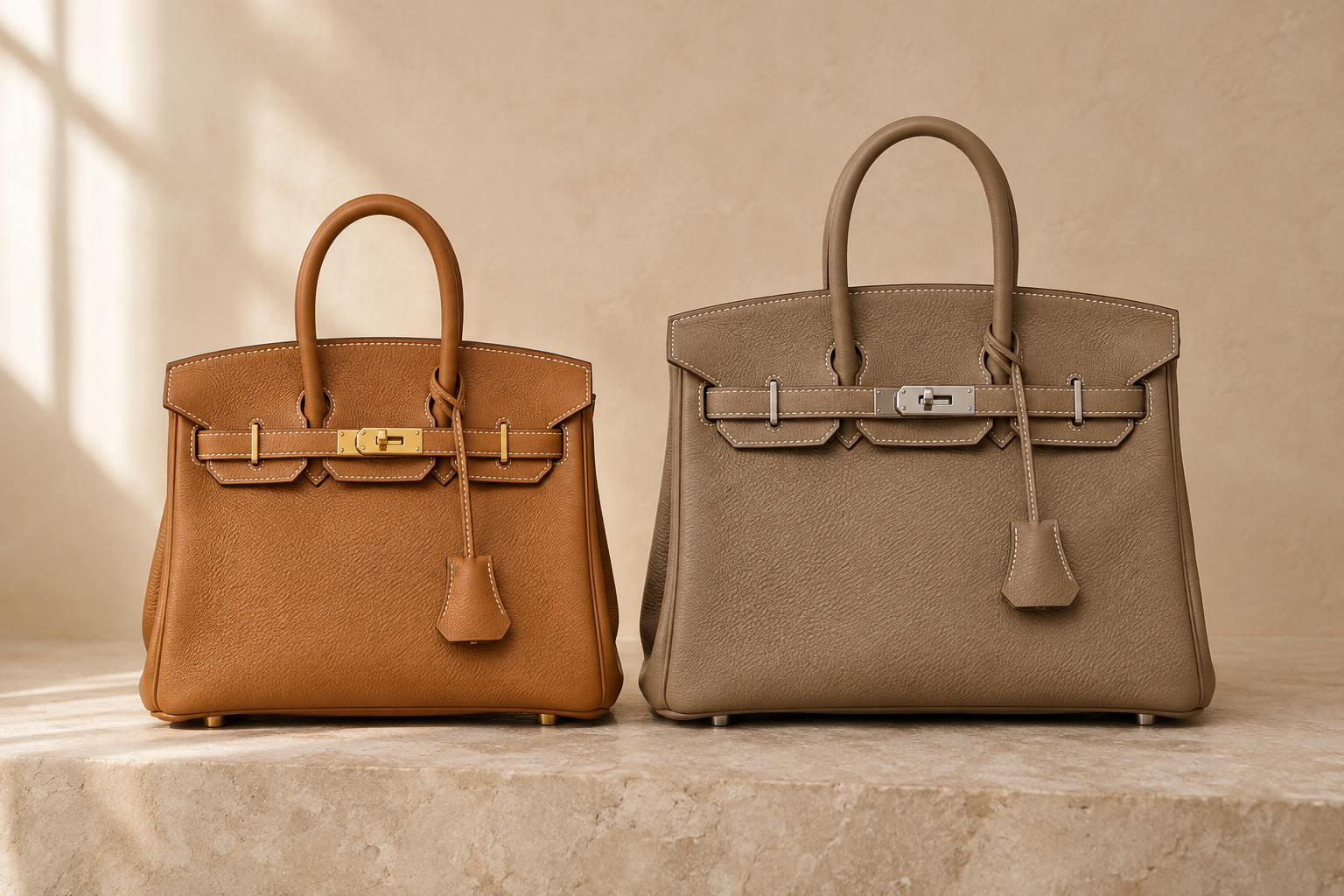

Five centimetres can change the character of a bag. In the Hermès Birkin 25, the familiar silhouette feels compact and deliberate: a small, beautifully defined finishing touch. The Birkin 30 has a more generous presence, with room to accommodate the things a longer day tends to collect.
Both have their appeal. The useful question is how you want your Birkin to fit into everyday life.
For this Birkin 25 vs 30 comparison, I would start with the bag you already carry. What is always inside it? What do you regularly leave behind? And how often do you wish you could free up a hand?
Choose the Birkin 25 if you prefer a compact silhouette and carry a carefully edited set of essentials. Consider the Birkin 30 if you want more flexibility for daily extras. With either size, the handle fit and weight of your usual belongings deserve as much attention as the view in the mirror.
Birkin 25 vs 30: The Size Comparison
The table below gives approximate reference dimensions for the classic Birkin 25 and 30.
| Detail | Birkin 25 | Birkin 30 |
|---|---|---|
| Width × height × depth | Approx. 25 × 20 × 13 cm | Approx. 30 × 22 × 16 cm |
| Approximate dimensions in inches | 9.8 × 7.9 × 5.1 in | 11.8 × 8.7 × 6.3 in |
| Main appeal | Compact proportions | More room for everyday extras |
| Carrying consideration | Smaller handle opening; try your hand and wrist | More handle clearance; still worth testing |
| A useful starting point for | Essentials-focused days | Days when your packing list changes |
The centimetre measurements are consistent with Sotheby’s size guide and Christie’s listings for Togo Birkin 25 and Birkin 30 bags. Inch measurements are rounded conversions.
Published measurements can vary between individual bags and listings. Treat these figures as a comparison guide, then confirm the exact bag you are considering. They describe exterior dimensions, not tested interior capacity.
The 30 adds width, height, and depth. That extra depth is worth noticing when your everyday kit includes rigid objects, such as a glasses case or a cosmetics pouch.

What Fits in a Birkin 25 or 30?
A useful packing comparison begins with your actual belongings. Two people can both carry “a wallet and sunglasses” while needing very different amounts of space.
The examples below are planning suggestions, not a hands-on packing test or a guarantee that every item will fit together.
Birkin 25: Start with Your Essential Kit
Think in terms of a phone, compact wallet or cardholder, keys, and a few small personal items. This is the kind of pared-back routine that makes the 25 worth considering.
The important question is what happens when you add your least flexible item. A substantial sunglasses case, full-size wallet, or bulky pouch may change the arrangement considerably.
Try removing your phone and wallet without lifting out everything above them. A bag that closes only after careful rearranging may feel less convenient than you expected.
The 25 is especially appealing when you already enjoy carrying less. Buying a smaller bag to force a completely different routine takes more thought.
Birkin 30: Leave Room for the Extras
The 30 is the more promising starting point if your essentials are regularly joined by a notebook, an additional pouch, or other daily extras.
Use the additional space to assess access as well as capacity. Can you see what is inside? Can your wallet sit where you want it? Does the bag close comfortably without its sides being pushed outward?
For a tablet, bottle, or other bulky object, check the exact item against the opening and usable interior. Keep bottles securely sealed and separated from the lining.
Do not assume that a Birkin 30 is a laptop bag. Compare the dimensions of your device and sleeve with the actual interior, and test the fit with everything else you intend to carry.

Handle Comfort May Decide the Size for You
This is the detail I would test before choosing a color.
Sotheby’s notes the smaller handle opening on the Birkin 25 and the greater wrist-carrying room of the 30. Standard Birkin 25 and 30 bags are designed around top handles and do not come with a shoulder strap.
For the 25, check whether you can pass your hand comfortably through the handles if you want to carry it on your wrist. For the 30, test where the handles sit when the bag is loaded.
Try this with the sleeve and jewelry you normally wear. A bare-wrist fitting may tell you little about comfort over a thick cuff.
Also picture an ordinary moment: holding a coffee, opening a door, or reaching for your phone. If hands-free carrying is central to your routine, take that need seriously when considering either size.
Compare Packed Weight, Not Just Empty Weight
An empty bag gives you only part of the answer.
Leather, construction, hardware, and accessories can affect weight, so a single quoted figure should not stand in for every Birkin 25 or every Birkin 30. Ask about the exact bags you are comparing.
Then try a realistic load. Walk around briefly, change hands, and hold the bag in the position you would normally use.
The extra room in a 30 can invite extra packing. Before choosing it for flexibility, consider how much of that space you want to fill. If you are leaning toward the 25 for comfort, test that assumption with your own belongings inside.
Which Size Looks Better on the Body?
This is where personal taste deserves more room than a height chart.
To my eye, the 25 reads as a concentrated accent: appealing with a simple dress, a neat jacket, or an otherwise relaxed outfit. The 30 gives the Birkin silhouette more visual presence and can look particularly balanced alongside a long coat or generous tailoring.
These are styling impressions, not rules about who can wear which size. A petite person may love the presence of a 30; a taller person may prefer the compact contrast of a 25.
Compare both from the same distance and angle, ideally with your own outfit. Close-up photographs can exaggerate a bag’s apparent size, making online comparisons harder to judge.
For evening use, the 25 is an attractive starting point if your essentials fit. The 30 may make more sense when the same bag needs to accompany you through an entire day.
Leather and Construction Change the Comparison
Size is only one part of the silhouette.
Hermès describes Togo calfskin as having an irregular natural grain and a supple feel that softens over time. Its description of Epsom calfskin emphasizes a regular embossed grain and a firmer character that retains its shape.
Construction matters, too. As Sotheby’s explains, the classic Retourne has softer, rounded edges, while the Sellier uses visible exterior stitching for a sharper, more structured outline.
For the clearest size comparison, try to compare similar leather and construction. Otherwise, you may be responding as much to the firmness of one bag as to its dimensions.
When buying remotely, ask for photographs showing the bag standing naturally, without stuffing, as well as clear views of its opening and base.
Should You Use a Birkin Bag Organizer?
An organizer can be useful if you prefer separate places for keys, cosmetics, and other small belongings. Depending on its design, it may also provide some internal support.
It takes up space, however, and can affect the bag’s weight and outline. That trade-off deserves particular attention when you are choosing a compact bag with little spare room.
Check the organizer’s height, thickness, and compatibility with the exact size and construction. It should allow access to the bag’s pockets and closure without pushing against the sides.
At SAMORGA, we recommend confirming those details before choosing an insert. You can explore SAMORGA organizers for Birkin bags, including options listed for different sizes and constructions.
Choose the bag around your belongings first, then decide whether an organizer improves the arrangement.
Five Checks Before You Commit
- Bring your real essentials. Include the cases and pouches you actually use.
- Test the handles while loaded. Check hand and wrist comfort with your usual sleeves.
- Try the closure. Make sure it works comfortably with your belongings inside.
- Confirm the exact version. Note the leather, construction, condition, and included accessories.
- Compare the complete purchase. Review the seller’s verification process, return terms, and final cost.
For a pre-owned bag, request clear photographs of the handles, corners, base, hardware, and lining, and ask about repairs or alterations. A size that suits you perfectly still deserves a careful condition assessment.
Frequently Asked Questions
Is the Birkin 25 too small for everyday use?
It depends on your packing habits. It is a sensible size to consider for a compact essential kit. If you regularly add bulky cases, a notebook, or several pouches, begin by comparing the 30.
Can you carry a Birkin 25 on your wrist?
Some people can, but the handle opening makes this a personal fit question. Try it with your own hand, wrist, and clothing rather than relying on someone else’s photograph.
Is the Birkin 30 suitable for work?
It may suit a workday built around personal essentials and smaller accessories. If your work bag must carry a laptop, documents, or a bulky charger, test those exact items before deciding.
Is the Birkin 25 always more expensive than the 30?
Size alone does not determine a listing’s price. Compare the leather, condition, construction, included accessories, and seller, and distinguish a boutique price from a resale asking price. Check current quotations for comparable bags.
Which size should I choose for my first Birkin?
Start with the role you want it to fill. The 25 is worth considering for a compact bag you can use with a light load. The 30 is the stronger starting point when you want more room for changing daily needs.
The Size You Will Reach For
My starting recommendation would be the Birkin 25 for someone who already carries lightly, and the Birkin 30 for someone who values room to adapt.
Then let the practical fitting decide: your belongings, your hands, your clothes, and the way the bag feels after you have held it for more than a moment.
A beautiful Birkin should earn its place in your routine. The right size is the one that makes carrying it feel easy.
Editorial note: This research-based guide was checked on November 13, 2026. Dimensions are approximate published references; packing suggestions are not hands-on test results. Confirm specifications and fit for the individual bag.
AI-generated editorial imagery. Refer to the size chart and the individual bag for dimensions and fit.


Leave a Reply